Why You Need to Stop Giving Cloud Dictation Apps Your Voice Data
Quick Answer: Secure Voice Dictation
Standard cloud dictation apps often store your voice audio on centralized servers to train their AI models, posing a massive privacy risk. To keep your voice data secure, you should use local-first or BYOK (Bring Your Own Key) dictation apps like Wisprr. These tools process audio through a stateless API (like Groq) and delete the audio immediately, ensuring zero data retention.
The Vulnerability of Cloud Dictation
Voice data is biometric data. It is incredibly personal. Yet we hand it over to software startups without a second thought. Think about what you actually dictate on a given Tuesday: confidential client emails, private internal meeting notes, or just unstructured personal brain dumps.
When you use a standard cloud dictation service, your audio goes straight to their servers. They process it, and in a lot of cases, they keep it. Many of these companies explicitly state in their terms of service that they use your audio to train their models or improve their diagnostic tools. Even the ones that claim to delete the audio usually hold onto the metadata.
The Compliance Illusion
Yes, the enterprise-tier vendors heavily market their SOC 2 compliance and HIPAA readiness. But if you are a freelancer, an independent contractor, or just a regular user, you usually operate outside the protection of strict corporate data agreements.
You are subject to whatever the Terms of Service say today, and that can change tomorrow. The psychological discomfort of broadcasting your spoken thoughts to a third-party server is real, and relying on a startup's pinky-promise that they won't look at your data isn't a valid security strategy.
The Local-First BYOK Solution
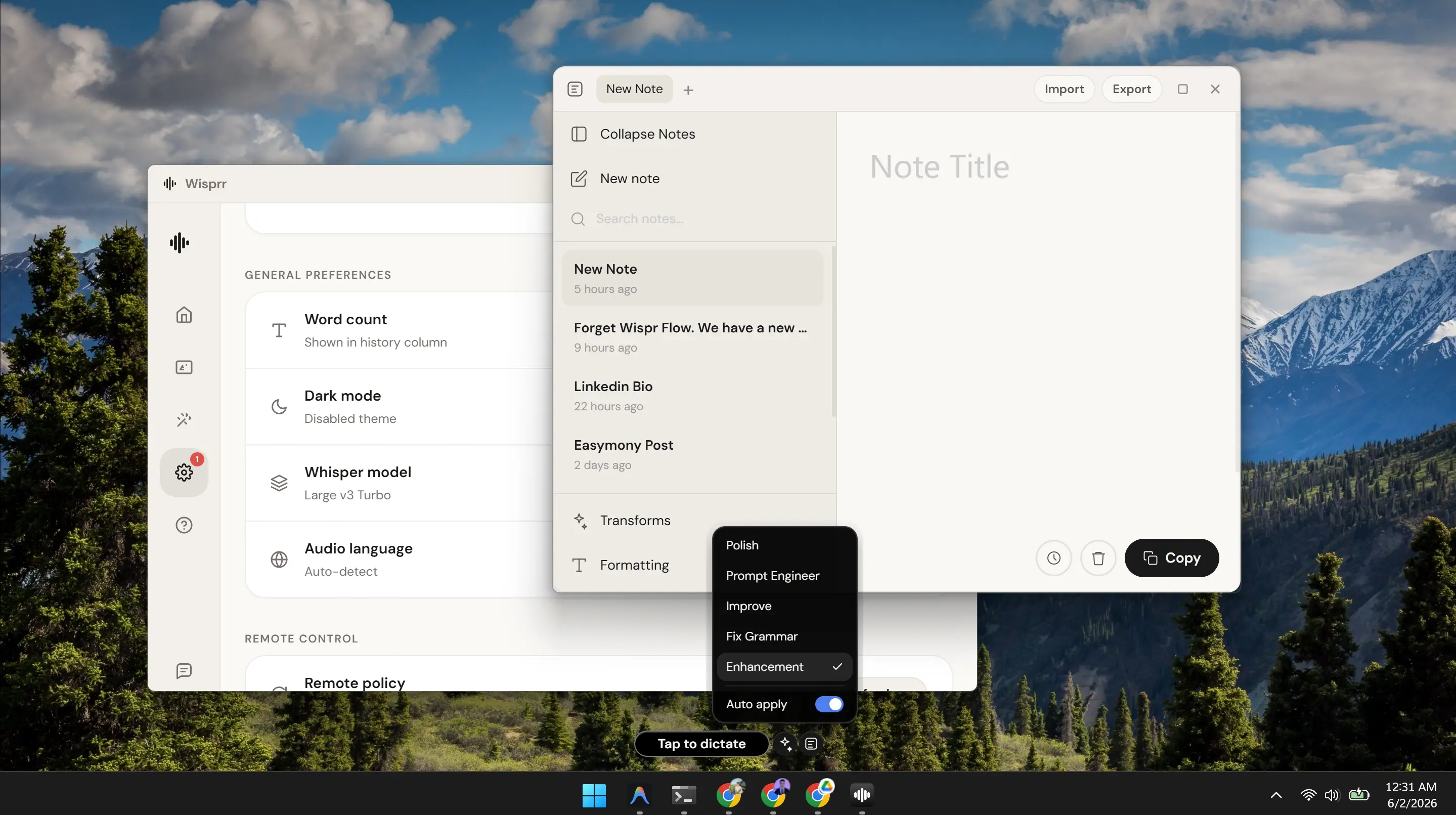
I built Wisprr to work differently. It relies on a hybrid local-first architecture.
Your settings, your transcription history, your notes, and your custom shortcuts all live strictly on your hard drive. We don't have a central database. We couldn't look at your dictations even if we were legally forced to.
For the actual transcription and AI cleanup, Wisprr uses a BYOK (Bring Your Own Key) model. You get an API key straight from the Groq developer console and paste it into the app. When you dictate, the audio goes directly to Groq over an encrypted HTTPS connection. Groq processes it in real-time, hands back the text, and deletes the audio immediately. They are engineered for stateless inference—they don't stockpile user voice profiles or historical logs.
Hackers can't steal your dictations from our servers because we don't have servers. The only way someone is getting your audio is if they physically steal your unlocked laptop.
Your voice data is too sensitive to hand over to companies with vague privacy policies. You should only use tools that rely on direct API connections and delete data the second they are done with it.
Related Articles
Free Wispr Flow Alternatives: The Best Voice Dictation Apps in 2026
Tired of hitting the 2,000-word limit on Wispr Flow's free tier? Here is how to use BYOK architecture to get unlimited, blazing-fast dictation without a $15 monthly subscription.
What is the Best Free Dictation Software for Windows?
Windows users usually get stuck with subpar native tools or expensive subscriptions. We built Wisprr to finally bring fast, free, AI-powered dictation to the PC.